“Natural” is the wrong goal for a phonics drill.
Every consumer voice tool races to sound smooth and human. For a six-year-old learning to hear English, that's exactly wrong — blended, fast, natural speech hides the very sounds they're trying to catch. So Languages Lab does something deliberate: it renders audio that is phonics-correct first, and saves the beautiful natural voice for stories.
The right voice for each pedagogical job.
Languages Lab routes each item to the engine built for it — automatically, based on what the item is.
Precision engine — for drilling
təˈmeɪtoʊ). Timed 500 ms breaks give learners space to repeat. The result is clarity, not gloss — each phoneme lands.- ✓Exact per-phoneme pronunciation & stress
- ✓Deterministic, precise timed breaks
- ✓Word-boundary timing that drives the karaoke highlight
Natural engine — for storytelling
- ✓Natural prosody for passages & dialogue
- ✓Character voices for stories
- ✓Gated by plan — available on Pro and up
A technical note that proves the point: newer natural-voice models drop precise SSML break control — so faithful phonics timing genuinely requires a strict, standards-based speech engine. That's why one engine can't do both jobs.
The drills teachers actually use — automated.
Word repeat
Sentence repeat
Repeat-after-me
Backchaining
Words light up in time with the voice.
Using real word-boundary timing from the speech engine, each word highlights exactly as it's spoken — so learners read and listen together, and can calibrate the sync to their own ear.
- ✓Millisecond-accurate karaoke highlighting
- ✓Per-learner speed and repeat-pause controls
- ✓Choice of curated voices per lesson
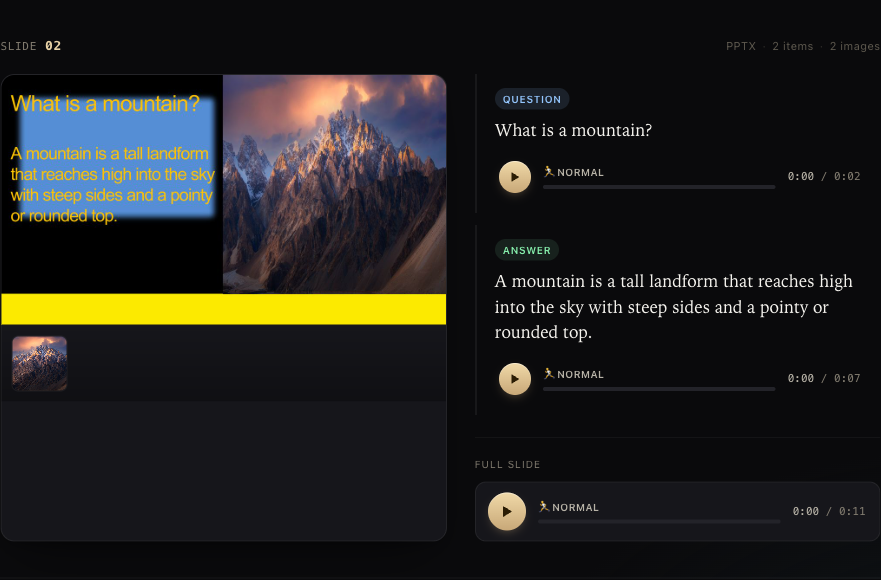
Hear the difference for yourself.
Upload a vocabulary page and compare a phonics drill to a natural read. Free to try.